
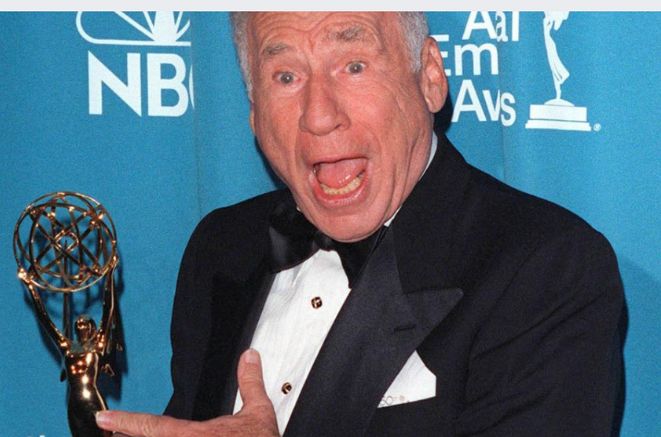
His most famous films were made between 1967 and 1995 (The Producers, Blazing Saddles). Mel Brooks is an outstanding personality, and although his artistic activity has significantly declined, he continues to work despite turning 96 this year.
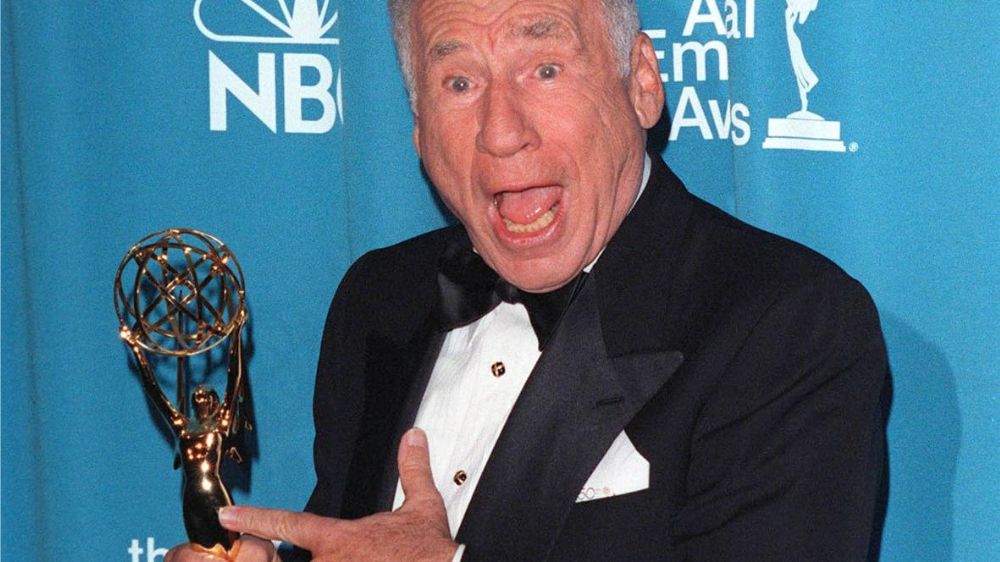
Who is Mel Brooks?
In recent years, Mel Brooks‘ artistic activity has significantly declined. Therefore, those who remember his films well may be very surprised that this extraordinary comedian, actor, film director and producer, as well as composer, turned 96 this year. His activity may have lost some of its intensity, but that does not mean he has retired. He is still working, although recently he has focused mainly on musical adaptations of his earlier films and voice-overs. In 2020, he surprised many by releasing a video in which he expressed his support for Joe Biden’s candidacy for US president in his own unique style. Until now, he has tended to avoid getting involved in current political issues.
His most famous films were made between 1967 and 1995. They were largely parodies of other well-known works, in which he specialized. Among them were titles such as The Producers (for which he received an Oscar), “Blazing Saddles,” and “Robin Hood: Men in Tights.” Not everyone appreciated his sense of humor, especially since he often shocked people. Some found his jokes too vulgar and obscene, at least at the time.
He also often targeted religion and politics in his parodies, which is why some people were outraged by the very fact that he touched on these “serious” topics in his “frivolous” films. Indeed, one could often get the impression that this man had no inhibitions and was ready to mock everything and everyone. Therefore, someone who was too down-to-earth and took life with deadly seriousness was unable to watch his films to the end. However, it would be wrong to think that Mel Brooks’ goal was to offend for the sake of offending. His comedies belong to the category of those that encourage us to look at life and ourselves with greater distance. In the case of Mel Brooks’ philosophy, this distance is very large.
A particularly recurring theme in Mel Brooks’ films were references to Jewish religion and culture. This was no coincidence, as he himself is Jewish. As for his national identity, Mel Brooks proudly acknowledges it, but at the same time considers himself a secular person. Therefore, in his case, there is no equivalence between being Jewish (a member of the nation) and being a Jew (a follower of Judaism). This fact – at least in part – neutralized accusations of anti-Semitism.
Mel Brooks – roots
He was born on June 28, 1926, in New York City under the name Melvin Kaminsky. However, his parents were from Europe. He later changed his name to Brooks, referring to his mother’s maiden name, Kate (Kitty) Brookman, among other reasons, so as not to be confused with the American jazz musician Max Kaminski.
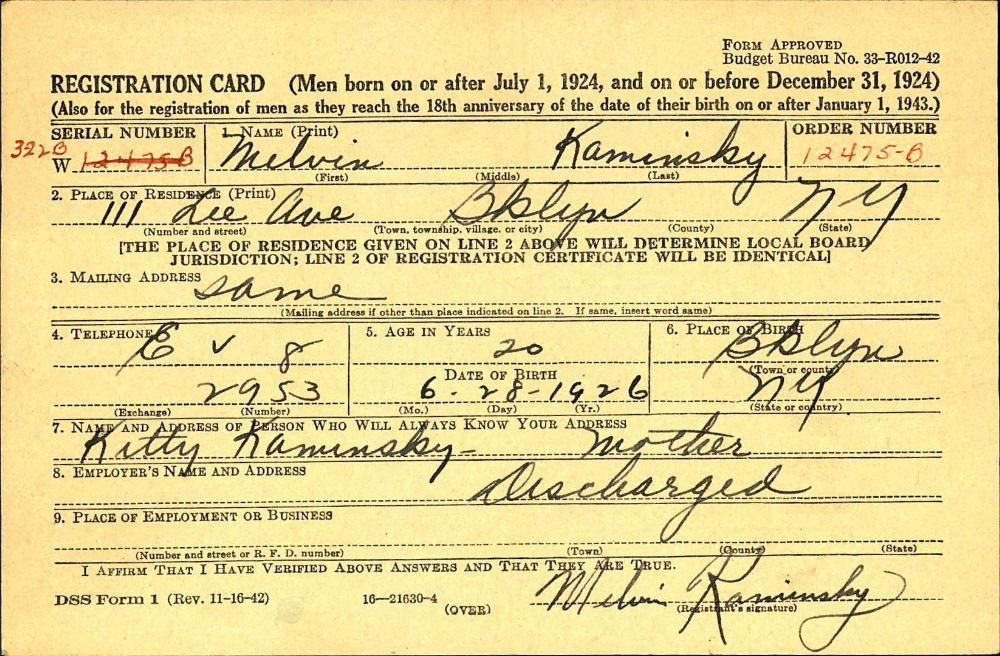
Information about his family can be found in pre-war American population censuses. As early as 1920, four people are listed: parents Max and Kate Kaminski and their two children, Irving and Leonard. According to this census, the parents of the future comedian were born in Russia and spoke Yiddish. The census also shows that Max’s father was born in 1893 and his mother Kate in 1897. They arrived in America separately, in 1896 and 1899, respectively. In the next census from 1925, another child appears – Bernard Kaminsky – and the information about the parents’ Russian origin is repeated.

As for the origins of his father, Max Kaminski, in the 1910 census, he is listed alongside his eight siblings as the son of Abraham Kaminski and Berta. Interestingly, English is listed as the “native language” for all of them, with only the mother’s language listed as Yiddish. However, there is also a list of passengers on the ship “Scandia,” which Max Kaminsky, along with his sister Marta and mother Berta, was supposed to have sailed to America on in 1896. All of this would be consistent with the documents discussed earlier. However, this passenger list states that the Kaminskys came from the town of Kallwen in East Prussia. It turns out that this was a tiny town located on the Memel River, on the very border between German East Prussia and Russia (today’s Lithuania). This could partly explain why the 1930 census states that Mel Brooks’ father came from Germany. However, there are still some inaccuracies regarding their origin, especially when we take a look at the popular Wikipedia, which states that Max Kaminsky came from Gdańsk.
As for his mother’s origins, there is information that she came from the vicinity of Kiev in present-day Ukraine. However, the matter is not so clear-cut when we consult the sources. The 1905 and 1910 censuses list Katie Bruckman alongside four or five siblings. Her father was said to be Isaac (Ike) Bruckman and her mother Minnie. Interestingly, there is a document certifying that Katie and her sister Mary were placed in a Jewish orphanage in New York in 1906. It is not known whether the two girls actually ended up there and for how long, as they are listed in the 1910 census. However, the family was probably in a difficult financial situation. These documents list the family’s place of origin as “Russia” without specifying which region of Russia the Brookmans might have come from.

Max Kaminsky and Kate (Kitty) Brookman married in 1916 in New York. Mel was only three years old when he lost his father. Years later, he seemed to suggest that his distance from religion and faith may have been rooted in his inability to come to terms with the early loss of his father, whom he hardly knew. While Mel Brooks’ father died very early, in 1929, his mother lived to a ripe old age, passing away in 1989.
Mel Brooks, on the other hand, married actress Anne Bancroft in 1964. As reported in the press at the time, their wedding passed without much publicity (Anne was already a well-known and respected actress), as the bride appeared under her real name, Anna Maria Italiano. They formed a successful relationship and a harmonious artistic duo, often participating in the same projects. She starred alongside her husband in the 1983 film “To Be or Not to Be,” a new interpretation of the 1942 war comedy of the same title directed by Ernst Lubitsch. The film is naturally set in occupied Poland, with Mel Brooks and Anne Bancroft playing Polish theater actors. They even tried their hand at the difficult Polish language on screen. They were married until Anne Bancroft’s death in 2005.
Summary
So, although documents suggest that Mel Brooks’ ancestors may have come from what is now Lithuania, Ukraine, or possibly Gdańsk, and above all that they were of Jewish origin, his father’s familiar-sounding surname, Kamiński, makes one feel a certain “kinship” or at least a “kinship” with him. Regardless of Mel Brooks’ roots, his sense of humor can appeal to people in any geographical location, as long as we maintain a sense of distance from ourselves.
![Pre-war Polish countryside in archival photographs [GALLERY]](https://yrip.brkts.com/wp-content/uploads/2026/02/Miniaturka_polska_wies-1-1.png)